William Law (1686-1761) *****
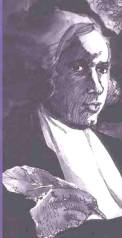
William
Law, born in 1686, became a Fellow of Emmanuel College, Cambridge in 1711, but
in 1714, at the death of Queen Anne, he became a non-Juror: that is to say, he
found himself unable to take the required oath of allegiance to the Hanoverian
dynasty (who had replaced the Stuart dynasty) as the lawful rulers of the
United Kingdom, and was accordingly ineligible to serve as a university teacher
or parish minister. He became for ten years a private tutor in the family of
the historian, Edward Gibbon (who, despite his generally cynical attitude
toward all things Christian, invariably wrote of Law with respect and
admiration), and then retired to his native King's Cliffe. Forbidden the use of
the pulpit and the lecture-hall, he preached through his books. These include
Christian Perfection, the Grounds and Reasons of Christian Regeneration, Spirit
of Prayer, the Way to Divine Knowledge, Spirit of Love, An Humble ~ Earnest,
And Affectionate Address To The Clergy, The Way to Divine Knowledge. And, best-known of all, A Serious
Call To a Devout and Holy Life, published in 1728.
The
thesis of this last book, "AN HUMBLE ~ EARNEST, AND Affectionate ADDRESS
TO THE CLERGY" is that God does
not merely forgive our disobedience, he calls us to obedience, and to a life
completely centered in Him. He says: "If you will here stop and ask
yourself why you are not as pious as the primitive Christians were, your own
heart will tell you that it is neither through ignorance nor inability, but
because you never thoroughly intended it." The immediate influence of the
book was considerable. William Law died in 1761 just a few days before his last
book, "AN HUMBLE ~ EARNEST, AND
Affectionate ADDRESS TO THE CLERGY", went to the printers.
Dr.
Samuel Johnson said: "I became a sort of lax talker against religion, for
I did not think much against it; and this lasted until I went to Oxford, where
it would not be suffered. When at Oxford, I took up Law's Serious Call,
expecting to find it a dull book (as such books generally are), and perhaps to
laugh at it. But I found Law quite an overmatch for me; and this was the first
occasion of my thinking in earnest of religion after I became capable of
rational inquiry." Gibbon (as mentioned above) said: "If Mr. Law
finds a spark of piety in a reader's mind, he will soon kindle it into a
flame."
John
Wesley calls it one of three books which accounted for his first "explicit
resolve to be all devoted to God." Later, when denying, in response to a
question, that Methodism was founded on Law's writings, he added that
"Methodists carefully read these books and were greatly profitted by
them." In 1744 Wesley published extracts from the Serious Call, thereby
introducing it to a wider audience than it already had. About eighteen months
before his death, he called it "a treatise which will hardly be excelled,
if it be equalled, either for beauty of expression or for depth of
thought."
Charles
Wesley, George Whitefield, Henry Venn, William Wilberforce, and Thomas Scott
each described reading the book as a major turning-point in his life.
All in all, there were few leaders of the
English Evangelical movement on whom it did not have a profound influence.
Andrew
Murray said of Law's Affectionate Address to the Clergy . . . "I do not
know where to find anywhere else the same clear and powerful statement of the
truth which the Church needs at the present day. I have tried to read or
consult every book I knew of, that treats of the work of the Holy Spirit, and
nowhere have I met with anything that brings the truth of our dependence on the
continual leading of the Spirit, and the assurance that that leading can be
enjoyed without interruption, so home to the heart as this teaching ...which I
believe to be entirely scriptural, and to supply what many are looking for . .
."
Sidney
Spencer said, "William Law holds an outstanding position among Protestant,
and among English, mystics. He was influenced by many other mystics - He was
familiar with the work of most noteworthy Christian mystics from the
pseudo-Dionysius in the fifth century to Mme. Guyon in the seventeenth."
His encounter with the works of Jacob Boehme opened in him new heights of
inspiration. "In his literary career there is a blank of nine years -
between An Appeal to all that Doubt the Truths of the Gospel (1740) and the
first part of the Spirit of Prayer (1749). It seems to have been during this
period that Law undertook the systematic study of Boehme. Law's mysticism is
essentially related to his understanding of religion as an inward principle,
grounded in the deeper nature of the soul. The inmost centre of our being is
for him the 'spark of the soul' which is divine and which moves us therefore to
seek after union with God."
Stephen
Hobhouse said of William Law: "He strongly disapproved of critics; he
wished his books to be read 'more with the heart than with the head' and he
warns us again and again against 'that learning, which, robbing us of the true
fruits of the Tree of Life, leaves us nothing to feed upon but the the dust of
words'." also "We hear, in England, Holland and Germany during the
17th and 18th centuries, of various associations of pious people styled
Behmenists, who might perhaps be classified as "Sects". The most vigorous
and interesting of these were the Philadephians. Their ablest member in England
was Francis Lee, M.D., of Cambridge (1661-1719) known personally to J. Boehme's
greatest English disciple, William law and it may have been partly through Lee
that Law became interested in J.B. "
Some
of the works of William Law
AN HUMBLE ~ EARNEST, AND
Affectionate ADDRESS TO THE CLERGY
The Spirit of Prayer
T H E GROUNDS AND REASONS OF
CHRISTIAN
The Way To Divine Knowledge:
The Self Life By William Law
The Spirit of Love Part the First
In a Letter to a Friend by William Law
The Way to Divine Knowledge
See also MYSTICISM.